
Dudley, R. (2014). The Drunken Monkey: Why We Drink and Abuse Alcohol. Berkeley: University of California Press. 154 pp. [link] [youtube]
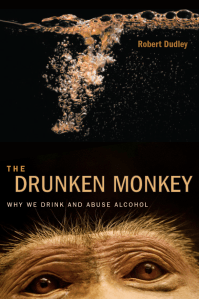
Alcoholism, as opposed to the safe consumption of alcohol, remains a major public health issue. In this book, I present a novel evolutionary interpretation to explain both routine low-level consumption of alcohol as well as persistence of alcohol-related problems. Providing a deep-time, interdisciplinary perspective on today’s patterns of alcohol consumption and abuse, I trace the link between the fruit-eating behavior of tropical primates and the evolution of sensory skills required to localize ripe and fermented fruits that contain sugar and low levels of alcohol. In addition to introducing this new approach to the relationship of humans to alcohol, the book discusses supporting research, implications of the hypothesis, and the medical and social impacts of alcoholism.
Reviews:
“Chemistry: Intoxicating Science”, Nature (15 May 2014) [link]
“The Drunken Monkey”, Times Higher Education (29 May 2014) [link]
“The Drunken Monkey: Why We Drink and Abuse Alcohol”, American Journal of Human Biology (Nov. 2014) [link]
Recent scientific literature relevant to the “drunken monkey” hypothesis:
Dominy, N.J., Fannin, L.D., Vogel, E.R., Robbins, M.M. and C. Hobaiter. (2025). Fermented fruits: scrumping, sharing, and the origin of feasting. BioScience 75:774-778.
Bowland, A.C., Bersacola, E., Ramon, M., Bessa, J., Melin, A.D., Carrigan, M.A., Harrison, X.A. and K.J. Hockings. (2025). Wild chimpanzees share fermented fruits. Current Biology 35:R279-R280.
Bowland, A.C., Melin, A.D., Hosken, D.J., Hockings, K.J. and M.A. Carrigan. (2024). The evolutionary ecology of ethanol. Trends in Ecology and Evolution 40:67-79.
Bouchebti, S. et al. (2024). Tolerance and efficient metabolization of extremely high ethanol concentrations by a social wasp. Proceedings of the National Academy of Sciences USA DOI: 10.1073/pnas.2410874121
Casorso, J.G. et al. (2023). Seed dispersal syndrome predicts ethanol concentration of fruits in a tropical dry forest. Proceedings of the Royal Society B 290:20230804.
Pinto, S.L. et al. (2023). Diet and the evolution of ADH7 across seven orders of mammals. Royal Society Open Science 10:230451.
Amato, K.R. et al. (2021). Fermented food consumption in wild nonhuman primates and its ecological drivers. American Journal of Physical Anthropology DOI: 10.1002/ajpa.24257 [link]
Nevo, O., Schmitt, M.H., Ayassee, M. and K. Valenta. (2020). Sweet tooth: elephants detect fruit sugar levels based on scent alone. Ecology and Evolution DOI: 10.1002/ece3.677 [link]
Janiak, M.C., Pinto, S.L., Duytschaever, G., Carrigan, M.A. and A.D. Melin. (2020). Genetic evidence of widespread variation in ethanol metabolism among mammals: revisiting the ‘myth’ of natural intoxication. Biology Letters 16:20200070. [link]
Ibanez, D.D., Salazar, L.T.H. and M. Laska. (2019). Taste responsiveness of spider monkeys to dietary ethanol. Chemical Senses 20:1-8. [link]
Ranger, C.M. et al. (2018). Symbiont selection via alcohol benefits fungus farming by ambrosia beetles. Proceedings of the National Academy of Sciences USA 115:4447-4452. [link]
Peris, J.E., Rodriguez, A., Pena, L. and J.M. Fedriani. (2017). Fungal infestation boosts fruit aroma and fruit removal by mammals and birds. Scientific Reports 7:5646. [link]
Cains, S., Blomeley, C., Kollo, M., Racz, R. and D. Burdakov. (2017). Agrp neuron activity is required for alcohol-induced overeating. Nature Communications 8:14014. [link]
Gochman, S.R., Brown, M.B. and N.J. Dominy. (2016). Alcohol discrimination and preferences in two species of nectar-feeding primate. Royal Society Open Science 3:160217. [link]
Hockings, K.J. et al. (2015). Tools to tipple: ethanol ingestion by wild chimpanzees using leaf-sponges. Royal Society Open Science 2:150150. [link]
Dominy, N.J. (2015). Ferment in the family tree. Proceedings of the National Academy of Sciences USA doi:10.1073/pnas.1421566112 [link]
Carrigan, M.A., Uryasev, O., Frye, C.B., Eckman, B.L., Myers, C.R., Hurley, T.D. and S.A. Benner. (2015). Hominids adapted to metabolize ethanol long before human-directed fermentation. Proceedings of the National Academy of Sciences USA doi:10.1073/pnas.1404167111 [link]
Devineni, A.V. and U. Heberlein. (2013). The evolution of Drosophila melanogaster as a model for alcohol research. Annual Review of Neuroscience 36:121-138. [link]
Orbach, D.N., Veselka, N., Dzal, Y., Lazure, L. and M.B. Fenton. (2010). Drinking and flying: does alcohol consumption affect the flight and echolocation performance of phyllostomid bats? PLOS ONE DOI: 10.1371/journal.pone.0008993 [link]
Sánchez, F., Melcón, M., Korine, C. and B. Pinshow. (2010). Ethanol ingestion affects flight performance and echolocation in Egyptian fruit bats. Behavioural Processes 84:555-558. [link]
Mazeh, S., Korine, C., Pinshow, B. and R. Dudley. (2008). Does ethanol in fruit influence feeding in the frugivorous yellow-vented bulbul (Pycnonotus xanthopygos)? Behavioural Processes 77:369-375. [link]
Wiens, F., Zitzmann, A., Lachance, M.-A., Yegles, M., Pragst, F., Wurst, F.M., von Holst, D., Guan, S.L. and R. Spanagel. (2008). Chronic intake of fermented floral nectar by wild treeshrews. Proceedings of the National Academy of Sciences USA 105:10426-10431. [link]
 Animal Flight Laboratory | University of California, Berkeley